
Sponsored by: Lorikeet
Eucalyptus 4x'd patient volume and lifted CSAT 10 points with the same team.
Lorikeet's AI concierge handles prior auth, billing, pharmacy refills, and care coordination across their stack. HIPAA, BAA, SOC2. Built for digital-native healthcare.

Welcome back, folks —
Let’s get straight to it:
General AI vs clinical AI
AI making healthcare more expensive?
Abridge is making its biggest move yet
21 new tools/partnerships, 3 funding updates, new AI jobs & link-worthy content
Read time: 6 minutes
Our Picks ✨
Highlights if you’ve only got 2 minutes…
1/
General AI vs clinical AI
A new Nature Medicine paper is stirring up debate after finding that frontier LLMs outperformed healthcare-specific tools like OpenEvidence and UpToDate Expert AI across multiple medical benchmarks. The study tested models on MedQA, HealthBench, and 100 real physician queries reviewed by 12 blinded U.S. clinicians, with GPT-5.2, Gemini 3.1 Pro, and Claude Opus 4.6 coming out ahead.
OpenEvidence quickly pushed back on the results, but we’re also a bit surprised the paper went as viral as it did given the relatively small sample size and that these things change all the time. This paper also comes as many organizations are moving in the opposite direction. Just last week, we wrote about Mayo Clinic and Microsoft partnering to build a healthcare-specific frontier model, while Abridge also just announced a healthcare-specific foundation model with Nvidia, and its current healthcare-tuned model improved CDI performance from 69% to 85%.
We think this will have very minimal impact on OpenEvidence. Even if frontier models are strong, products can incorporate those same models, and doctors seem to prefer tools built specifically for clinicians. The bigger battle may be around trust, workflow, and distribution rather than the benchmark back and forth. (link)

2/
AI making healthcare more expensive?
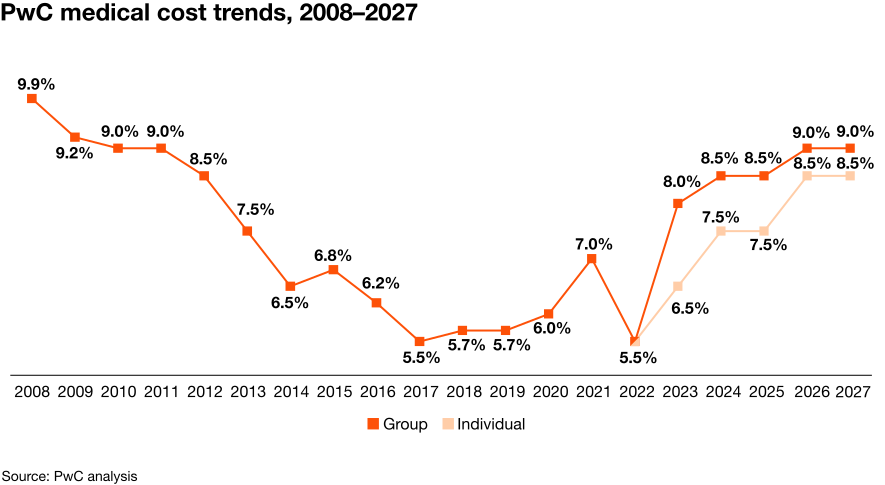
One of the biggest promises of AI is lower healthcare costs. So far, the data may be pointing in the opposite direction.
PwC projects medical costs will rise 9% in 2027, the highest increase in 17 years, with healthcare spending on track to exceed $9T annually by 2035. One surprising driver: AI-powered documentation and coding tools. Nearly 70% of health plans surveyed ranked AI-enabled revenue optimization among their top cost inflators as providers use these tools to capture more billing complexity and higher reimbursement levels.
It's a good reminder that AI doesn't change incentives, it amplifies them. And healthcare's current incentives still reward doing more, coding more, and getting paid more.
Long term, AI should absolutely improve outcomes, reduce administrative burden, and make care more proactive. But in the short term, it may simply make the existing system more efficient at extracting revenue. A real unlock here could be payment models that reward lower costs and better outcomes vs just better AI. (link)
3/
Abridge is making its biggest move yet
Abridge used its first keynote event to make it clear it's no longer just an AI scribe company. The company unveiled what it calls an AI-native clinician intelligence platform, designed to support clinicians before, during, and after patient visits while connecting health systems, payers, and life sciences organizations through a single workflow layer.
There were a lot of announcements coming out of this. Eli Lilly made a strategic investment as Abridge expands into clinical trial matching and research workflows. Nvidia partnered with Abridge to build a healthcare-specific foundation model trained on real-world clinical conversations. And both Cigna and Aetna discussed how AI-powered clinical workflows could help move the industry closer to real-time claims adjudication and value-based care.
As AI documentation becomes increasingly commoditized, many of these companies are expanding into broader workflow and intelligence layers. Abridge is making a strong push to become the trusted interface sitting on top of healthcare's existing infrastructure. It's impressive to see how quickly the category is evolving and where the industry could be heading next. (link)(linkedin)

Tools & Partnerships 🔧
Latest on business, consumer, and clinical healthcare AI tools and partnerships…
TOOLS
Anthropic pulls flagship AI models after government concerns: Anthropic disabled public access to Fable 5 and Mythos 5 just days after launch, following U.S. government security concerns tied to their advanced capabilities in scientific research and drug discovery. (link)
Google unveils camera-based heart monitoring: The company introduced an AI-powered system that uses a smartphone camera to measure heart rate and estimate resting heart rate without wearables. (link)
Tampa General reports major sepsis gains with AI: The health system says its Palantir-powered sepsis detection platform has reduced sepsis mortality by more than 50% since 2022, with earlier detection contributing to 68% fewer 48-hour deaths and an estimated 900 lives saved. (link)
CMS launches health technology office: CMS created the Office of Health Technology and Products to lead interoperability efforts, promote open standards, and drive secure data exchange across its programs. (link)
Congress moves to block Medicare AI prior auth pilot: The House Appropriations Committee voted to eliminate the WISeR program, an AI-powered prior authorization pilot that faced criticism over costs and access to care. (link)
Cognizant launches Physical AI platform: The new platform aims to connect robotics, lab automation, and medical devices into a unified AI layer for healthcare operations. (link)
AI adoption surges across federal health agencies: A Bipartisan Policy Center analysis found AI use cases increased across every HHS agency in FY2025, led by a 148% jump at the FDA, as federal health organizations expand AI for research, operations, and public health initiatives. (link)
Cedar’s AI voice agent nears 400,000 patient calls: Since launching in 2025, Cedar’s healthcare billing assistant Kora has handled nearly 400,000 patient calls, helping providers reduce call center workload while improving collections and patient satisfaction. (link)
CVS launches AI Learning Academy: CVS Health is rolling out an enterprise-wide AI training program to build workforce AI skills and help employees adopt generative AI tools across the organization. (link)
Oracle bets on AI to reignite EHR growth: Oracle expects double-digit growth for Oracle Health next year as it rolls out an AI-powered overhaul of the Cerner EHR and expands outcome-based pricing models. (link)
Patients embrace AI when it’s cheaper: A Johns Hopkins study found AI screening uptake nearly doubled when copays were waived, though most patients still wanted a clinician to verify the results. (link)
University of Utah scales Hospital at Home with AI: The health system uses AI to continuously identify eligible patients for home-based care, helping expand its Heal at Home program across more than 20 specialties. (link)
Stanford’s AI discharge summaries reduce burnout: An in-house AI agent that drafts hospital discharge summaries helped reduce physician burnout in a pilot study. (link)
UCLA Health launches AI evaluation center: The new INOVAi Center will study the safety, effectiveness, and real-world implementation of healthcare AI tools, from usability testing through clinical trials and deployment. (link)
Ambitious Bio emerges to build AI-ready biology datasets: The startup launched from stealth with a focus on generating large-scale biological datasets designed to power the next generation of biomedical AI models. (link)
Karias Health launches AI care companion: Faith helps patients understand care decisions by summarizing visits, translating physician guidance into actionable tasks, and recommending high-quality, lower-cost providers. (link)
MySeniorCareHub debuts AI-powered senior care platform: The all-in-one platform combines health monitoring, medication reminders, wearables integration, and an AI assistant to support seniors, caregivers, and families. (link)
PARTNERSHIPS
OSF HealthCare + hellocare: OSF HealthCare expanded its partnership with hellocare to deploy AI-assisted intelligent hospital rooms across its system, integrating virtual nursing, patient safety, and engagement tools into a unified platform. (link)
Memorial Sloan Kettering + SOPHiA GENETICS: Memorial Sloan Kettering partnered with SOPHiA GENETICS to advance AI-powered precision oncology through genomic analysis and cancer research. (link)
Caregility + Microsoft: Caregility partnered with Microsoft to bring Dragon Copilot’s AI documentation capabilities into smart hospital rooms, enabling hands-free nursing documentation and workflow support. (link)
Yale New Haven Health + Rad AI: Yale New Haven Health expanded its partnership with Rad AI to deploy radiology AI tools systemwide and co-develop new imaging technologies. (link)
Deal Desk 💰
Spotlight on latest capital raises, M&A, and investments…
FUNDING
Radical Numerics, a Menlo Park-based AI research lab for biological data, raised $50M in seed funding. Emergence Capital led. (link)
Turnout, a San Diego-based benefits claims navigation platform, raised $35M at a $400M post-money valuation led by HighPost Capital. (link)
Uncovr, a provider of clinical documentation and workflow intelligence for surgery, raised $7M in seed funding. Index Ventures led. (link)

as of 6/15/26
Other Relevant News 🔍
News, podcasts, blogs, tweets, resources, etc…
Visuals of the Week 📸
Funny memes, cool pics, and interesting data from around the web…


That’s it for this week friends! Back to reading — I’ll see you next week.
Stay classy,
PS. I write this newsletter for you. So if you have any suggestions or questions, feel free to reply to this email and let me know
How was this week's newsletter? Tap your choice below👇

