

Sponsored by: Siggy
What happens to psychiatric patients between appointments?
Siggy tracks it. From the co-founders of Nurx and Journey Clinical, Siggy turns daily check-ins, wearable data, and medication adherence into one score clinicians use to adjust treatment in real time. AI handles intake; licensed providers make every call. Covered by insurance in all 50 states, including Medicare Advantage. Learn more

Good morning, readers —
Well… Jensen is back (which we hinted at last week).
Meanwhile, Anthropic just pulled off one of the largest IPOs in history, healthcare AI spending hit $3.7B, and HLTH brought another wave of launches, agents, and partnerships.
Quite the week. Here are the main stories:
HLTH 2026 health AI recap
Anthropic goes public. Jensen is back.
Healthcare is AI’s biggest vertical
Plus: 50+ updates across tools, partnerships, research, policy, and deals, along with AI jobs and more.
Read time: 10 minutes
Our Picks ✨
Highlights if you’ve only got 2 minutes…
1/
HLTH 2026 health AI recap
Hope you had a productive HLTH if you made it to Vegas. We covered a number of the pre-HLTH announcements in last week’s newsletter, so we won’t repeat those here. But there was still plenty of AI news from the show floor:
OpenAI expands computer-use agents in healthcare: Showed agents working with CVS, Cigna, Abridge, and Ambience to complete multi-step workflows across EHRs and payer portals, including software without APIs. In one EHR inbox evaluation, 99% of 325 reviewed tasks were rated safe. OpenAI also added 20+ healthcare plugins. (link)
Scale AI launches hospital agents: Rolled out agents for referral triage, order guidance, chart review, patient safety investigations, and documentation quality, designed to run across different models inside health system environments. (link)
ElevenLabs expands into healthcare: Launched voice agents for scheduling, intake, outreach, claims, and RCM. Angle Health says 90%+ of provider calls handled by its agents are resolved without a transfer. (link)
Apple + OpenEvidence launch a 200K-person study: Apple is studying how consumers use conversational health AI, with OpenEvidence providing the underlying clinical intelligence. (link)
Suki launches Suki OS: Expanded beyond ambient documentation into an agentic operating system for clinical, operational, and revenue cycle workflows. (link)
Ambience moves into inpatient orchestration: Launched AI for rounding and discharge readiness. One customer reported a 6.5% improvement in case mix index after needing 1.5% to justify the investment. (link)
Abridge expands Assistant: Added Wiley clinical intelligence and opened Assistant to 108K community health center clinicians serving roughly 52M Americans. (link)
Doximity expands at NewYork-Presbyterian: Bringing Doximity Ask directly into Epic alongside Scribe across NYP, Columbia, and Weill Cornell. (link)
Viz.ai + Wolters Kluwer: Bringing UpToDate Expert AI directly into Viz.ai’s care coordination workflows. (link)
Availity opens its network to agents: Availity Extend gives applications and agents access to eligibility, claims, prior auth, payments, and other workflows through APIs and MCP. Its network connects 95%+ of health plans and 4.5M+ providers. (link)
b.well launches infrastructure for consumer health AI: health.space lets AI apps embed care providers and services directly into their experiences, while new health skills give agents more structured clinical workflows. (link)
TytoCare pushes AI further into the home: Launched an AI platform combining remote exams, devices, and health data to help health systems manage high-risk patients between visits. (link)
The same issues kept coming up across HLTH. RCM is still where AI proves ROI fastest, but simpler workflows may get bundled into Epic and other incumbents within 6 to 12 months. Provider coding AI is already pushing payers to deploy more AI of their own, raising the risk that we’ll just automate denials, prior auth, and reimbursement fights faster. And closer to the point of care, the bottlenecks are increasingly data quality, liability, workflow access, and reimbursement vs. model capability. Plenty of FDA-cleared AI tools still have no clean way to get paid, while CMS’s ACCESS model could start opening a path for prevention and wearables tied to outcomes.
Our main takeaway from HLTH: the model itself feels less like the bottleneck than it did a year ago. The hard part now is connecting AI to reliable data, giving it permission to act, proving the economics, and figuring out who gets paid when it actually improves care.

2/
Anthropic goes public. Jensen is back.
Pretty wild week for the AI trade…
Anthropic pulls off one of the largest IPOs ever: Anthropic priced at $83 and ultimately sold $93.5B of stock in its IPO, alongside a $26B private placement. The company was incorporated in 2021 and has since gone from $41M in revenue in 2023 → $386M in 2024 → $4.6B in 2025 → $33.2B through the first nine months of 2026.
The founders’ wealth creation is equally crazy. Anthropic’s seven founders each held roughly $20B of stock at the IPO price, or around $139B combined. That works out to roughly $66M of paper value created per day across the founders since the company was incorporated.
Anthropic also walks away with one of the largest war chests in tech. Its post-IPO balance sheet has roughly $245B in cash, cash equivalents, and short-term investments, more than Apple, Amazon, Microsoft, Meta, or Nvidia individually. It also has enormous compute commitments ahead, so plenty of that money already has somewhere to go.
What stood out most was where Anthropic says this is all going. One of the fastest-growing companies in history, fresh off one of the largest IPOs ever, put curing major diseases in the 2nd sentence of its IPO deck. Its materials explicitly call out a $2T+ life sciences market and drug discovery alongside knowledge work, with Eli Lilly as one of just five flagship customer stories.
Anthropic goes even further in its prospectus, arguing AI could accelerate biology and medicine enough to help cure cancer, Alzheimer’s, heart disease, rare genetic diseases, and major infectious diseases.
Hard to miss the signal. Science and medicine are a major part of the frontier AI pitch. (link)
Jensen is back: Nvidia unanimously reinstated Jensen Huang as CEO, president, and board member less than two weeks after his resignation. The board said it received input from senior levels of the US government and is confident his return poses no national security risk. Its independent investigation will continue.
His return looks broadly good for the AI trade, US AI leadership, open source, and healthcare AI. Huang has pushed Nvidia well beyond chips into Nemotron, open models and datasets, BioNeMo, drug discovery, genomics, and scientific computing.
There’s also an interesting Anthropic connection. Nvidia invested $10B in Anthropic’s $26B private placement. Nvidia benefits as Anthropic consumes more compute, while Jensen is simultaneously pushing an open-model ecosystem that could put more pressure on proprietary frontier models. Nvidia can win on both sides. (link)
Taken together, both stories look broadly bullish for AI, although Jensen’s return cuts both ways for Anthropic. It strengthens a major investor and infrastructure partner, but also brings back one of the strongest advocates for open models and competition at the model layer. For healthcare, it’s harder to see the bearish case.
One of the fastest-growing technology companies ever just raised an enormous amount of capital while telling investors that drug discovery and curing disease are major applications of its technology. Meanwhile, one of the world’s most important computing companies gets its founder back, and he has made biology, healthcare, scientific computing, and open AI core parts of Nvidia’s strategy.
The frontier labs are talking about curing disease. Nvidia is building the compute and tooling underneath them. Pharma is pouring money into AI. Clinical adoption is accelerating.
A huge amount of capital, compute, and talent is starting to point in the same direction.
Health AI is starting to look less like one vertical of the AI boom and more like one of the main reasons to build the technology in the first place. We’ve been saying it all along. Onwards!

3/
Healthcare is AI’s biggest vertical
Menlo Ventures’ latest report estimates healthcare AI spending hit $3.7B in 2026, up 2.5x year over year. That makes healthcare 37% of all vertical AI spending, more than double legal, and larger on its own than the entire vertical AI market was last year. A few things stood out:
Providers still dominate: $2.9B, or 77% of healthcare AI spend.
AI is moving closer to the patient: clinical copilots grew 5.5x to $550M and patient engagement grew 4.5x to $450M, versus 1.6x for scribes and 1.3x for coding and billing.
Bio is breaking out: life sciences AI spend jumped from $30M to $700M as pharma moved from pilots into production.
Adoption keeps climbing: 42% of healthcare organizations now use domain-specific AI, up from 22% last year.
The easy categories are getting crowded: ambient scribing is now a $950M market, but Epic and Microsoft captured 68% of new spending as every major EHR rolled out its own scribe.
EHR loyalty fades closer to the patient: 75% of providers would prefer chart review from their EHR and 71% say the same for billing and coding. That preference drops sharply for prior auth, patient navigation, clinical decision support, and other workflows farther from the core EHR.
Payers are still behind: external payer AI spend was just $150M, even as 43% say provider coding AI is already increasing their medical cost trend.
There’s a pretty clear pattern in all of this. The first wave was notes, coding, and admin. Those markets are getting crowded fast. The next wave is moving into harder problems around clinical decisions, patient interaction, care delivery, and drug discovery.
And the market could get a lot bigger from here. Annual US labor spend is roughly $140B for lawyers, $250B for software engineers, and $1.4T for healthcare workers.
Healthcare already leads vertical AI spending, but the labor pool underneath it is larger than legal and software engineering combined.
Our prediction: healthcare eventually becomes a bigger AI application market than legal and coding combined. We’re still so early. (link) (tweet)

TOGETHER WITH TEMA ETFs
Invest in healthcare’s next era. The Tema Healthcare AI ETF (HLTH) invests in companies using AI to transform drug discovery, diagnostics, clinical application and patient care. 👉️ Click here to learn more!
Healthcare AI Rundown 🔍
Latest on tools, partnerships, research and policy…
Tools & Product Updates 🔧
Epic plans access for outside AI agents in 2027: Authorized third-party agents will be able to retrieve Epic data through Model Context Protocol, a standard connecting AI to external tools, starting in Q1. (link)
Amazon expands AI agents for patient access: Amazon Connect Health now handles scheduling, prescription requests, portal password resets and routine questions around the clock, with contextual handoffs to staff when needed. (link)
OpenEvidence passes 2M clinical consultations in a single day: The company says verified U.S. clinicians generated more than 2M consultations in 24 hours, marking a new usage record. (link)
Photon brings clinician-reviewed prescribing into ChatGPT: Verified clinicians can draft, review and send prescriptions within ChatGPT, while patients receive a text to compare pharmacies and choose where to fill them. (link)
Artera launches AI agents for patient intake: Artera Intake collects and checks patient information through text, voice and web, writes into supported EHRs, and gives staff a dashboard showing outstanding tasks. (link)
Mosaic Reporting surpasses 100,000 radiology reports daily: The company says its AI-assisted reporting platform handles 75% of Radiology Partners Clinical Services’ daily reports, with more than 14M exams reported to date. (link)
Parallel launches healthcare search built for AI agents: The service helps agents retrieve and cite primary sources, including FDA drug labels, clinical trial records, CMS information and published medical research. (link)
Jiva introduces an interactive AI diagnostic research system: Its clinical reasoning layer chooses follow-up questions, investigates warning signs and determines when enough information has been collected to propose a diagnosis and triage decision. (link)
Ant Group open-sources 2 medical AI models: Afu’s LingSante family includes models for multimodal health interpretation and complex clinical reasoning, alongside specialized capabilities for risk prediction, safety and video consultations. (link)
Xlue develops a model for predicting health trajectories: The company aims to use longitudinal clinical data to predict disease risk and simulate treatment effects, helping clinicians and researchers explore possible outcomes before acting. (link)
Hidden Health Data turns public PDFs into research datasets: An open pipeline extracts and validates information from scattered healthcare documents, starting with Medicaid quality-review reports and expanding to other state and regulatory records. (link)
OpenAI releases GPT-6.2 Astra and Sol: The models target complex professional projects and everyday work, with OpenAI reporting stronger performance and fewer output tokens across demanding tasks. (link)
Google launches Gemini 4 Neon for complex agent workflows: The model supports coding, scientific analysis and multimodal tasks with a 1M-token context window, with Google reporting 32% lower cost per task than Gemini 4 Carbon. (link)
Partnerships & Deployments 🤝
R1 + Ascension: The partners renewed their revenue cycle agreement through fiscal 2037, following Ascension’s enterprise deployment of Phare OS to support financial and administrative workflows. (link)
mdhub + Amen Clinics: Amen Clinics selected mdhub’s AI-first EHR across 11 locations, expanding an existing documentation partnership to connect scheduling, intake, clinical records, billing and patient engagement. (link)
Concurrence + Thriveworks: The partnership starts with AI-assisted documentation across a network of 2,800 clinicians, including session transcription, clinician-reviewed notes and direct EHR entry. (link)
Vera Health + American Diabetes Association: Vera is adding the ADA’s Standards of Care in Diabetes and selected professional resources to its medical search platform, with citations to original guidance. (link)
Viz.ai + Wolters Kluwer: UpToDate Expert AI will integrate into Viz.ai One, letting specialists ask patient-specific clinical questions and access supporting evidence within existing care coordination workflows. (link)
Wiley + Abridge: Cochrane systematic reviews and Clinical Answers will inform cited responses in Abridge Assistant, with full-text access available to Wiley subscribers. (link)
Abridge + NACHC: Abridge Assistant will be available free to 108,000 community health center clinicians, including those who do not use Abridge’s documentation product. (link)
Doximity + NewYork-Presbyterian: Clinicians across NYP, Columbia and Weill Cornell will gain access to Doximity Ask within Epic, alongside a separate AI tool for clinical documentation. (link)
Basata + Unio Health Partners: Unio will deploy AI-assisted referral processing, insurance verification and voice scheduling across 60+ specialty locations serving more than 550,000 patients annually. (link)
Color Health + NCI-designated cancer centers: Collaborations with centers including MSK and Moffitt will coordinate workups, records and intake, targeting first appointments within 7 days for most referred patients. (link)
Noetik + Memorial Sloan Kettering: The collaboration will use data spanning tens of thousands of patients to develop cancer biology models for target discovery and treatment-response prediction. (link)
Research & Evidence 🔬
Healthcare buyers expect fewer standalone AI vendors: Black Book’s survey of 412 buyers found median portfolios could shrink from 9 vendors to 5 by 2028; 63% of Epic systems anticipate replacing at least 1 tool. (link)
Only 40% of hospital leaders can measure AI returns: Bain’s survey of 100 administrators found just 10% had redesigned core workflows around AI, despite substantial spending on the technology. (link)
Health systems put numbers behind AI returns: Rush reports approximately $3.3M net from SmarterDx chart reviews, while Sutter reports 20,000 physician hours saved with Abridge; results remain organization- and workflow-specific. (link)
Bonbon learns molecular interactions from 3.2T training tokens: Output Labs’ preprint reports biological reasoning capabilities and laboratory validation across 9 disease targets, including compounds targeting proteins outside the model’s training distribution. (link)
Wearable-AI benchmark tests whether health advice confuses cause and correlation: CausalHealthBench evaluates reasoning from wearable data; its authors report that additional data can make correlation-based conclusions more confidently wrong. (link)
OpenAI expands researcher access alongside productivity findings: The program targets up to 200,000 researchers. Surveyed pilot participants estimated that equivalent research without AI would take nearly twice as long, a self-reported result. (link)
Doctronic reports 63% of consultations happen after hours: The company says 9pm is its busiest hour, with 13% of consultations starting between midnight and 6am, highlighting demand beyond traditional office hours. (link)
Medicare analysis maps physical limits to AI substitution: The perspective estimates that roughly 21% of payments cover non-visit services without physical barriers to automation; it does not demonstrate that AI can replace that work. (link)
Exin demonstrates an AI-guided procedure on a mouse: The company says an agent selected a gene therapy and brain target and operated a surgical rig, with a veterinarian handling skull opening and emergency oversight. (link)
Policy, Governance & Industry 🏛️
ONC and CMS move electronic prior authorization into testing: Voluntary, 10–12-week testing sprints will evaluate connected authorization workflows in production-like environments, helping participants identify implementation gaps before broader deployment. (link)
HHS finalizes a shorter deadline for patient records: The HIPAA update will cut the standard response period from 30 to 15 calendar days and strengthen access through compatible personal health apps. (link)
FDA launches a central hub for AI resources: The hub brings together product-specific guidance, regulatory information and updates on the agency’s own AI use across drugs, devices and other regulated products. (link)
Kaiser clinicians secure contract provisions addressing AI: About 2,400 mental health clinicians ratified a four-year agreement that includes no-layoff protection and a process for clinician input on AI. (link)
St. Jude gives researchers flexibility to test public AI: Eligible investigators can experiment with non-patient lab data, while clinical applications involving protected health information face additional review under the hospital’s risk-based governance framework. (link)
Tahoe Forest restricts AI after a patient-data upload: The health system disclosed that an employee uploaded identifiable patient information to ChatGPT for analysis, prompting restrictions, staff training and a review of data protection policies. (link)
Hospitals race to patch an AI-discovered Java vulnerability: Cybersecurity company Calif says AI helped find the flaw in about 1 hour; Oracle issued a patch, and CISA urged organizations to address it. (link)
Mayo names its AI program leader as next CEO: Matthew Callstrom, medical director for strategy and generative AI, will succeed Gianrico Farrugia as president and CEO on January 1, 2027. (link)
Deal Desk 💰
Spotlight on latest capital raises, M&A, and investments…
FUNDING
Isomorphic Labs, an AI drug design company, raised $5B in Series C funding. Greenoaks and Sequoia Capital co-led, joined by Andreessen Horowitz and Alphabet. (link)
Science Corporation, a clinical-stage maker of brain-computer interface vision restoration technology, raised $400M in Series D funding. Khosla Ventures, Ackman Oxman Institute, and Tenet participated, among others. (link)
Boltz, an AI platform that designs molecules for drug discovery, raised $110M in Series A funding. Bessemer Venture Partners led, joined by Andreessen Horowitz and F-Prime Capital. (link)
Noeri, a Palo Alto, Calif.-based lab building self-improving AI for enterprises and scientific discovery, launched with $110M in funding. Menlo Ventures led, joined by Madrona Venture Group and NEA. (link)
Remedy Robotics, a San Francisco-based maker of AI-enabled endovascular robots, raised $62M in Series B funding. DCVC led, joined by UC Investments and Skip Capital. (link)
Aevius, a Boston-based clinical intelligence company spun out of Mass General Brigham, raised $22M in seed funding. Insight Partners led. (link)
ODAIA, an AI commercial intelligence platform for pharma, raised $15M in Series C funding led by Monograph Capital and anchored by PHM. (link)
Current Surgical, a Washington, DC-based surgical technology company, raised a $9.5M Seed+ round. (link)
Tesorai, a San Diego-based AI company building a searchable knowledge layer for life sciences, raised $5.3M in seed funding. Perplexity Fund, IQT, South Central Ventures participated among others. (link)
Treat, a Helsinki-based provider of AI-assisted intake and digital doctor consultations, raised €3M in pre-seed funding. byFounders and Illusian led. (link)
M&A
Credo Health + Affineon Health: Credo acquired Affineon and relaunched as Pajama.ai, combining AI chart preparation with inbox automation for clinicians. (link)
VENTURE FUNDS
Norwest, a global investment firm, closed a $4B multi-stage fund to fuel investments in healthcare, biotech, AI, and other sectors. (link)
Other Relevant News 🔍
News, podcasts, blogs, tweets, resources, etc…
AI Job Opportunities 💼
Explore our AI Job Board or contact us to feature roles in our newsletter…
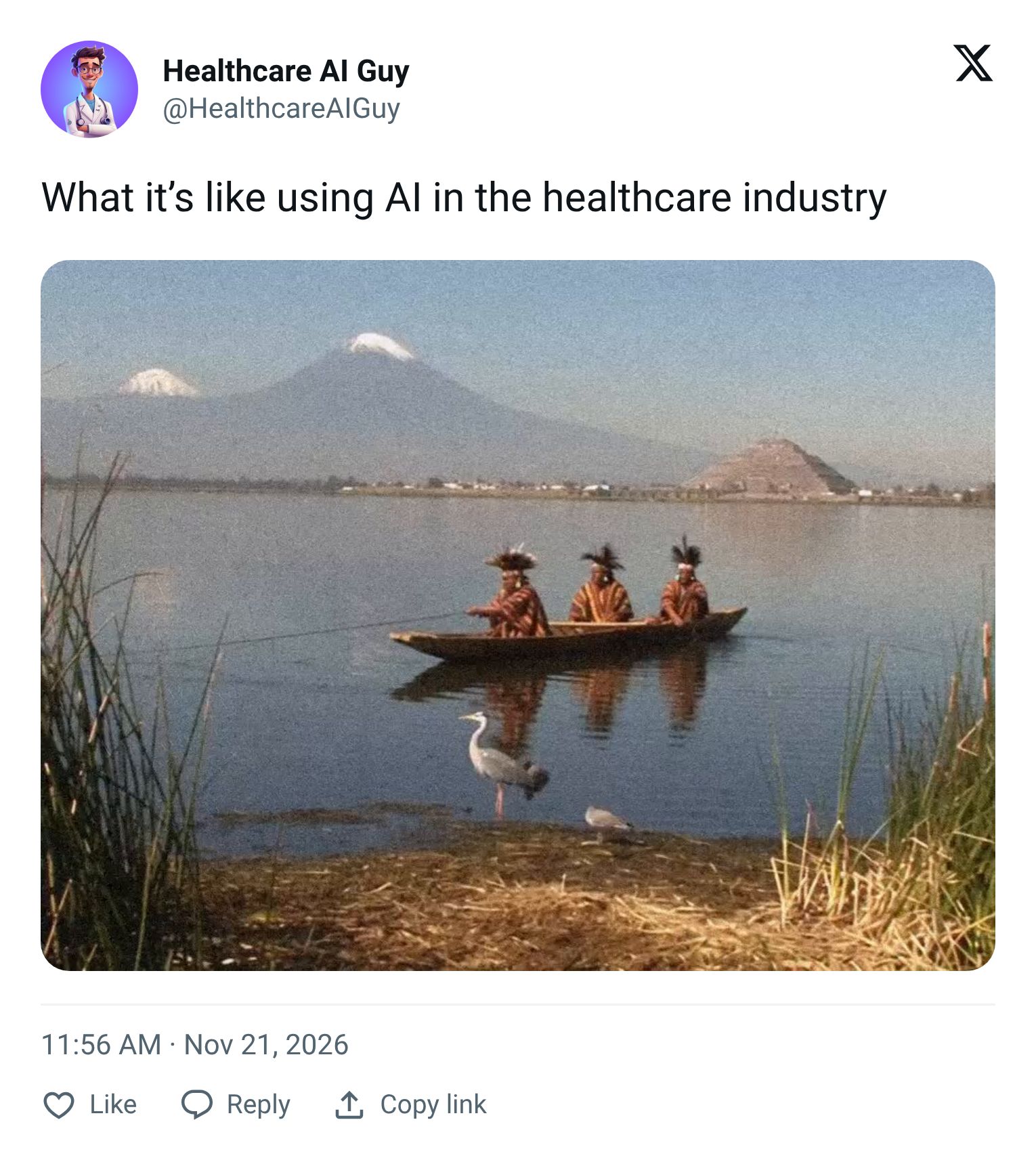
Visuals of the Week 📸
Funny memes, cool pics, and interesting data from around the web…


That’s it for this week friends! Back to reading — I’ll see you next week.
Stay classy,
PS. I write this newsletter for you. So if you have any suggestions or questions, feel free to reply to this email and let me know
How was this week's newsletter? Tap your choice below👇

